


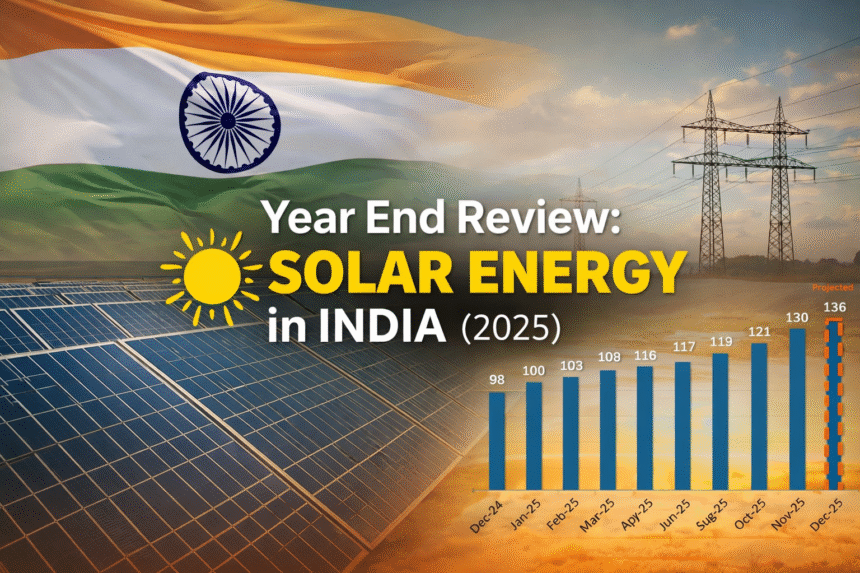
India’s solar sector delivered another landmark year in 2025, reinforcing its position as the backbone of the country’s clean energy transition. With record capacity additions, continued policy support, and expanding grid integration measures, solar power remained the fastest-growing segment of India’s renewable energy portfolio—driving both scale and system transformation.
Capacity growth: crossing 130 GW and counting
India’s cumulative installed solar capacity grew sharply through 2025, rising from 98 GW in December 2024 to 133 GW by November 2025. This translates into ~35 GW of net solar additions in just 11 months, marking one of the strongest annual expansion phases in the sector’s history.
Key milestones during the year included:
- Crossing 100 GW in January 2025, a symbolic moment for India’s solar journey
- Reaching 116 GW by June 2025, reflecting sustained project commissioning across utility-scale, rooftop, and distributed segments
- Touching 130 GW in October 2025, and closing November at 133 GW
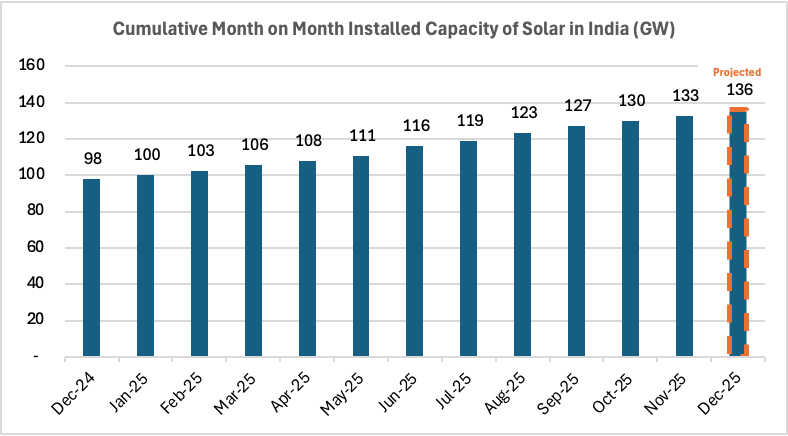
Based on the observed month-on-month trend, solar capacity is projected to reach ~136 GW by December 2025, underlining the continued execution momentum heading into the year’s close. Solar now accounts for over 65% of India’s total renewable energy capacity, making it the single most dominant clean energy source in the country’s generation mix.
Solar’s expanding role in India’s power system
While capacity growth remains impressive, 2025 also highlighted a shift in how solar is being integrated into the grid. As renewable penetration deepens, the focus is increasingly on system-level value, not just megawatts installed.
Solar deployment in 2025 was characterised by:
- Growing emphasis on hybrid (solar + wind) and RTC-linked projects
- Stronger linkage between solar parks and inter-state transmission systems
- Increased pairing of solar with battery energy storage systems (BESS) for peak shifting and firm power delivery
These trends reflect a maturing market, where solar is no longer viewed as standalone generation, but as a central component of a more flexible and resilient power system.
Policy actions in 2025: enabling scale, manufacturing, and grid readiness
A key enabler of solar’s growth in 2025 was continued policy support from the Government of India, particularly through the Ministry of New and Renewable Energy (MNRE) and allied institutions.
Major policy and programmatic developments included:
- Long-term target clarity:
The Government reiterated India’s commitment to 500 GW of non-fossil capacity by 2030, with solar expected to contribute the largest share. This long-term visibility continues to anchor investor confidence and large-scale project pipelines. - Domestic manufacturing push:
The Approved List of Models and Manufacturers (ALMM) regime remained a central pillar of solar policy in 2025, reinforcing domestic manufacturing, supply chain resilience, and quality assurance. This aligned closely with the Production Linked Incentive (PLI) schemes for high-efficiency solar modules. - Rooftop solar push under PM Surya Ghar:
A major contributor to distributed solar growth in 2025 was the PM Surya Ghar: Muft Bijli Yojana (PMSG). As of end-2025, the scheme has enabled 7,569.58 MW of installed rooftop solar capacity, reflecting strong uptake across residential households. The programme has played a critical role in- expanding grid-connected residential solar adoption, strengthening consumer participation in India’s energy transition, improving DISCOM visibility through structured subsidy and monitoring mechanisms. With implementation support from DISCOMs, banks, and state nodal agencies, PMSG is increasingly shaping the next phase of solar growth—from utility-led to consumer-driven deployment. - Grid and market reforms:
Policy discussions increasingly focused on forecasting, scheduling, curtailment management, and ancillary services, recognising the operational challenges of large-scale solar integration.
Together, these measures reflect a policy transition—from rapid capacity expansion to manufacturing depth, consumer participation, and grid integration.
Market signals: record auctions, selective execution
Solar procurement remained robust in 2025, with central agencies and states continuing to issue large utility-scale tenders. However, the market also displayed greater selectivity and discipline:
- Developers showed preference for projects with clear land, transmission access, and offtake security
- Tariffs stabilised compared to earlier aggressive bidding cycles
- Hybrid and storage-linked tenders attracted stronger interest than standalone solar in several cases
This evolution indicates a market that is maturing—prioritising bankability and execution certainty over sheer volume.
Looking ahead: from scale to system value
As India moves into 2026, the solar sector’s priorities are expected to evolve further:
- Deeper integration with storage and flexible resources
- Faster execution of transmission infrastructure
- Stronger alignment between DISCOM procurement and grid needs
- Continued expansion of rooftop and distributed solar
In summary, 2025 was a defining year for solar in India. The sector added ~35 GW, crossed 130 GW of installed capacity, and strengthened its role as the cornerstone of India’s clean energy transition. With policy backing, manufacturing momentum, and growing system-level integration, solar is well positioned to remain the dominant force in India’s power sector through the rest of the decade.