
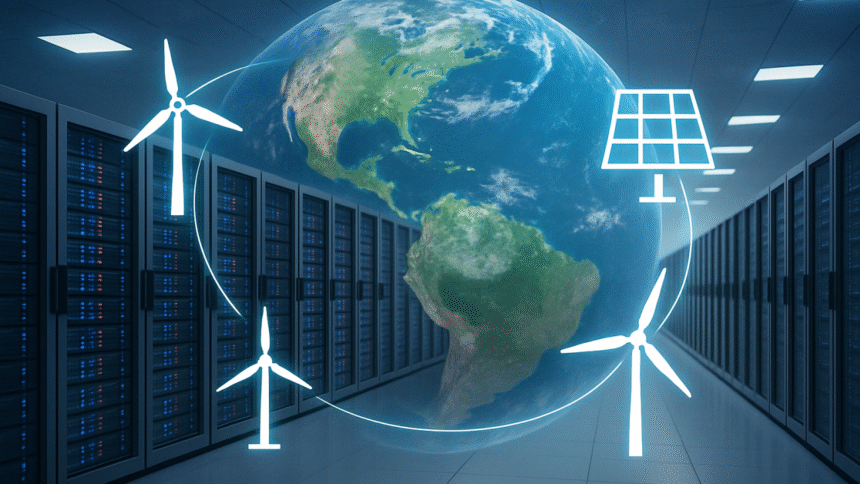
As a precursor to the India AI Impact Summit 2026, the International Solar Alliance (ISA), in partnership with the Ministry of Electronics and Information Technology (MeitY) and the Ministry of Power (MoP), convened a high-level dialogue on a Global AI Mission for Energy. The discussion also spotlighted India’s emerging vision of “AI Products for the World of Energy”, underscoring the country’s ambition to apply artificial intelligence (AI) at scale to modernise power systems, improve efficiency, and accelerate clean-energy adoption. The dialogue was reported by ET Energyworld on December 18.
The session brought together policymakers, technology leaders, power-sector experts, and international stakeholders to explore how AI can become a core enabler of next-generation energy systems. With global electricity demand expected to rise sharply—driven by electrification, electric mobility, and data centres—the role of intelligent, adaptive grids is becoming critical. Participants noted that AI can help utilities and system operators manage this complexity more efficiently while maintaining reliability and affordability.
A major focus area was smart grids. AI-based forecasting tools can significantly improve the accuracy of demand and renewable-energy generation forecasts, especially for variable sources such as solar and wind. This enables better scheduling of power plants, reduces curtailment of clean energy, and lowers system costs. Machine-learning algorithms are also being deployed globally to detect faults in transmission and distribution networks, reducing outages and improving power quality.
The dialogue also highlighted AI’s potential in energy efficiency and demand-side management. By analysing consumption patterns at the household, commercial, and industrial levels, AI can support dynamic tariffs, automated demand response, and energy-saving recommendations. For countries like India—where peak demand is rising rapidly—such tools can defer expensive grid upgrades while helping consumers lower their electricity bills.
Another key theme was resilience and climate readiness. Extreme weather events are increasingly disrupting power systems worldwide. AI-enabled early-warning systems, predictive maintenance, and asset-health monitoring can help utilities anticipate failures and respond faster to disruptions caused by heatwaves, floods, or cyclones. This is especially relevant for developing countries, where grid resilience is closely linked to economic and social stability.
India’s proposition of “AI Products for the World of Energy” positions the country not just as a user, but also as a developer and exporter of AI-driven energy solutions. With its large and diverse power system, expanding renewable-energy base, and strong digital public infrastructure, India offers a unique testing ground for scalable AI applications. Solutions developed in India—such as AI tools for solar forecasting, grid analytics, or loss reduction—could be adapted for other emerging economies facing similar challenges.
The Global AI Mission for Energy dialogue signals a growing convergence between digital innovation and the clean-energy transition. As preparations gather momentum for the India AI Impact Summit 2026, India’s approach reflects a broader vision: using AI not only to optimise its own energy systems, but also to contribute practical, affordable solutions to the global energy transition.